Gallery of the House of Culture in Zwoleń 23/06/2024, at 2 PM
Listen to the poem by Jan Kochanowski Tren X https://wolnelektury.pl/katalog/lektura/treny-tren-x/
Where is Orsola

The beyond, imaginary, mythological places have always played a central role in all cultures, whether for practical reasons to prepare for the afterlife, or as identity-shaping beliefs to gasp the eternal chaos and make it seemingly controllable.
Similar to Orpheus' journey to the underworld, the poet's voice in Tren X conjures different concepts of afterlifes to search for his beloved daughter. Starting with the Christian concept of angels in the kingdom of heaven, the highest place of thought, he descends into the underworld of Greek antiquity, the deepest imaginable place, opposing the Christian belief. Thus, he cuts
through the real world, as well as that of faith, in a single poetic movement, illustrating the father’s despair.
Henceforth, he "visits" all conceivable places of philosophical and religious beliefs: purgatory, the island of the blessed, the idea of transmigration of souls (Metempsychose), and even folk beliefs and dream imaginings, only to remain on his own. The final lines highlight further the despair that shakes his faith.

In each of these places, Orsola appears in a different form, corresponding to the place and its associated beliefs. Sometimes as a cherub, as a girl in Charon's boat, as a soul being cleansed, as a bird, and finally as a shadow and ghost.

Unlike in Orpheus' journey to the underworld, however, the authorities who reign and watch over these places are never invoked in Tren X, the poet calls the girl herself. Charon is only mentioned in passing but appears more as a continuous force occupied in his activity, while the poet addresses the girl, exercising his own authority as a father opposing the natural course.

All mentioned places of the afterlife seem to hold the same value for him, „wherever you may be"; it does not matter in which belief she is preserved, he even questions "if you exist", doubting the existence of all beliefs.

Finally, in utter despair and loss he calls her to „come back again“, in parental unconditional love, he doesn't care, accepting her even as a ghost, as long as she remains close to him.

But where is Orsola?
The question is both asked and answered simultaneously. She is preserved in the words, captured in the poem, in the poetry in eternal mourning, which withstands the wearing of time, and whenever read, even after hundreds of years, she will appear in the very same places, as a cherub, as a girl in a boat, as a soul being cleansed, happy, as a singing bird, while the father's grief echoes in the reader of the poem.

Preserved by the means of language, she remains in the collective memory, the place from which poetry arises and returns, transcending time.
In my artistic work, I engage with language and translation between German, English, Albanian, Italian, Spanish, and very recently also Polish. For this work, I studied the original Polish text, as well as the Italian, English, and German translations. The poet Kochanowski is largely unknown and has not been translated into the Albanian language, which is why the translation was
particularly important to me. I have endeavored to maintain the rhyme scheme as well as the stylistic means of expression. As an artist first and foremost, the power of imagery, as well as philosophical idea, is central to me. As much as possible, I have tried to preserve and highlight it’s stylistic subleties.
Finally, I have composed my response poem in English, Albanian, and German versions, using the same three languages for the response.
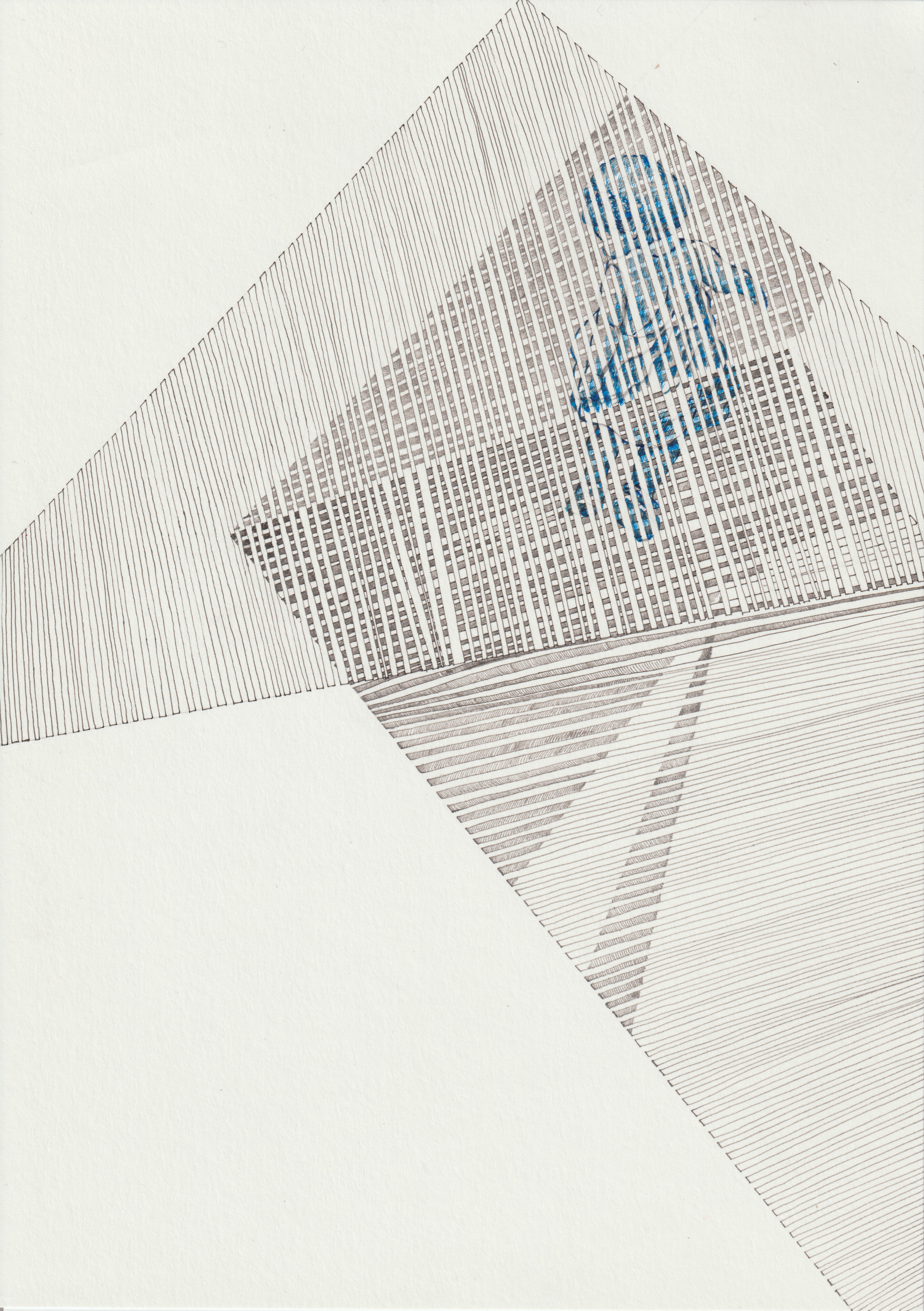
The drawing conveys another dimension of expression that does not require translation. The implied space defined by lines is fragmentized as the figure dissolved within it, broken down into its smallest form, the line. The figure is simultaneously form and shadow, visible and hidden at the same time.


 Borena Bodin